So you are looking for a stylus…
Unfortunately they are no longer made and cannot be rebuilt. But that doesn’t mean you can’t still find one…for now.
The most available source is eBay. Finding a specific stylus by itself can be quite expensive, usually with no guarantee that it will work.
Even NIB (New in Box) or sealed styli may not work right out of the box. If stored improperly or in poor conditions, the copper parts can corrode, glue can break, any number of manufacturing defects could have happened. When John Steven’s would acquire a large lot of “new” styli, he said about 20 percent of them didn’t work right out of the box. So be prepared.
If you can’t find a listing for your stylus or they are too expensive, another option is to buy a “parts player” and hope that it has a good stylus. At this point we have more players then we do styli and the styli is quickly becoming much more valuable then the player itself. So if you can find a player that uses the same stylus as yours then you can rob the stylus from it and put the player in storage in case you ever need parts from it. With failing IC chips and brittle plastic it’s good to have a backup machine to steal a button or part from.
But again, buying a parts machine is no guarantee the stylus will work, or that the player even has one in it.
There is no way to visually tell a stylus is good by looking at it. The only way to know for sure is to verify it in a known good player. So if your player works and you put a stylus in but only get “- -” on the display, then the stylus is probably bad. If you only have one player, you are more then welcome to send a stylus to me for verification on a known working machine. Email me at videodiscjunkie@gmail.com
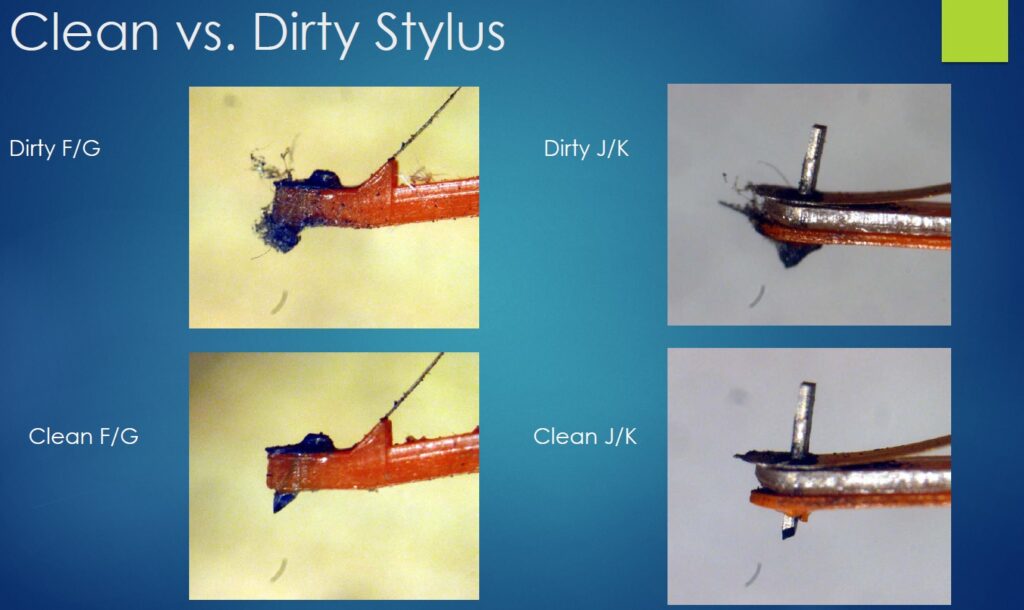
Sometimes cleaning a stylus can bring it back to life as well.
How to clean a stylus. https://youtu.be/4qVAPTHiWXg
To access your stylus on the RCA F/G players, these would be the ones with the light switch style on/off switch, and the SGT250. This is the same process for the Sears 274-54740150 player, Montgomery Ward and Toshiba Model Players, and the Zenith VP2000. You simply open the stylus access door, which will be the cover on the top of the player, usually released by a button on the 075 and 100 models, or will slide off towards the back on the SGT200 and SGT250. Once the door is off you should be looking at the stylus arm. If you are not, put the player in the load position and insert a disc to push the arm to the back of the player. Then remove the caddy and repeat this step again to unload the disc. With the player unloaded and the stylus arm in view, you can move the black bar on the center of the stylus arm door and lift up to reveal the stylus. The stylus should have a plastic handle that you can use to lift it out. To replace, just drop the new one in and close the door, make sure the black plastic latch is secure and replace the access panel door on the cover. You should be good to go again.
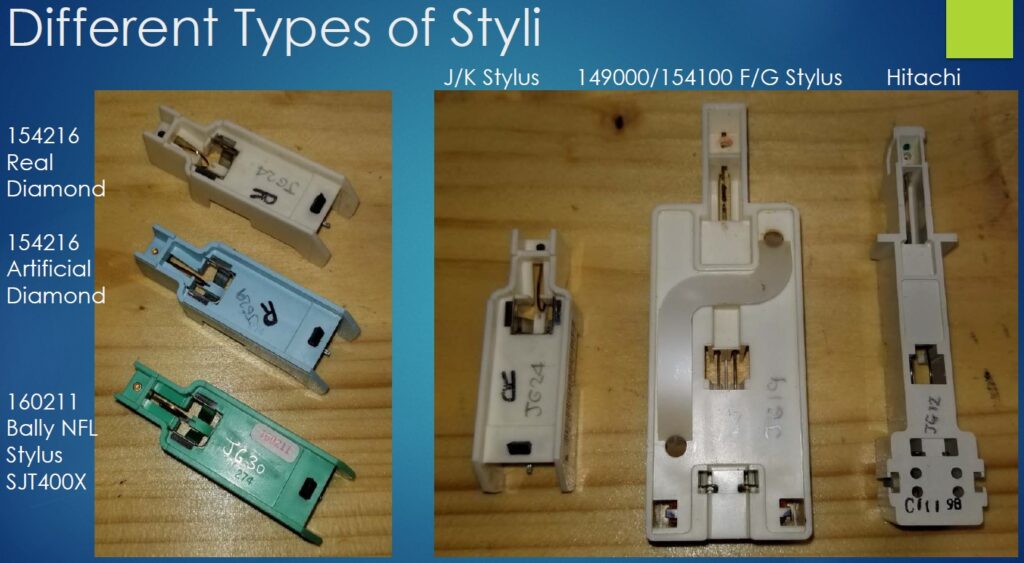
-These players use the 149000 mono stylus or the 154100 stereo stylus depending on weather you have a stereo player or not. The 149000 stylus will work in all players, but the 154100 stylus should only be used in stereo players, the SGT200, SGT250, and Toshiba VP500 & VP550.
Note: Mono F/G Players use 149000, Stereo uses 154100, in production 154100 was used in some mono players (SGT100 & SGT075 coded 2155 or later), to use 154100 in a mono player you must make sure it uses stylus arm 154036 with wide stylus sensors.
To access your stylus on the RCA J/K players, these would be the auto loading models with the button for power (excluding the SGT250), and the JcPenney player. You will need to plug in your player and power it on. Then with the player still on you will unplug the player from the power outlet. Next you will need to remove the top cover of the player. There will be two screws on the back edges of the player. Remove these and the top cover will lift off. You then have to rotate the 3rd reduction gear until the stylus arm comes into view and you can access the stylus arm cover. Again it will have a black bar on it that you will have to slide to lift up the stylus arm door. Then lift the stylus out, usually the front first and then the back so as not to upset the arm stretcher coil too much. To replace the stylus seat the back against the arm stretcher coil and lower the front down. Close the access door and secure the black bar in place. Then replace the top cover and when you plug the machine back in, it will power on and will automatically move the stylus arm back into loading position.
Click here for a video on how to change the stylus on a J/K player.
The final type of player is the Hitachi models, this also includes all Sears players (except the 274-54740150), the Realistic CED-1 Player, and all PAL players. These models have an access door on the left side of the player if you are facing the front of the player. Simply depress the center of the door and lift up and it will open to reveal the stylus arm. On the arm will be a small door with a white button, you just lift up on the white button to open the door. The stylus can then be lifted out, and a replacement dropped in. Then just close the stylus arm door and push it down to latch in place. Once the access door is replaced you are good to go again.
Here are the various styli available.
Some basic information about the stylus,
The stylus is a titanium electrode affixed to the trailing edge of a diamond tip. It follows in the V-shaped groove of the disc spinning at 450RPMs, which means the stylus is covering about 500cm/sec. If the stylus looses contact for even .3 mm an entire line of video information is lost. If the stylus is kicked over by 2.6 microns or one groove then 133 msec of audio and video information are lost or repeated. (We call this a skip)
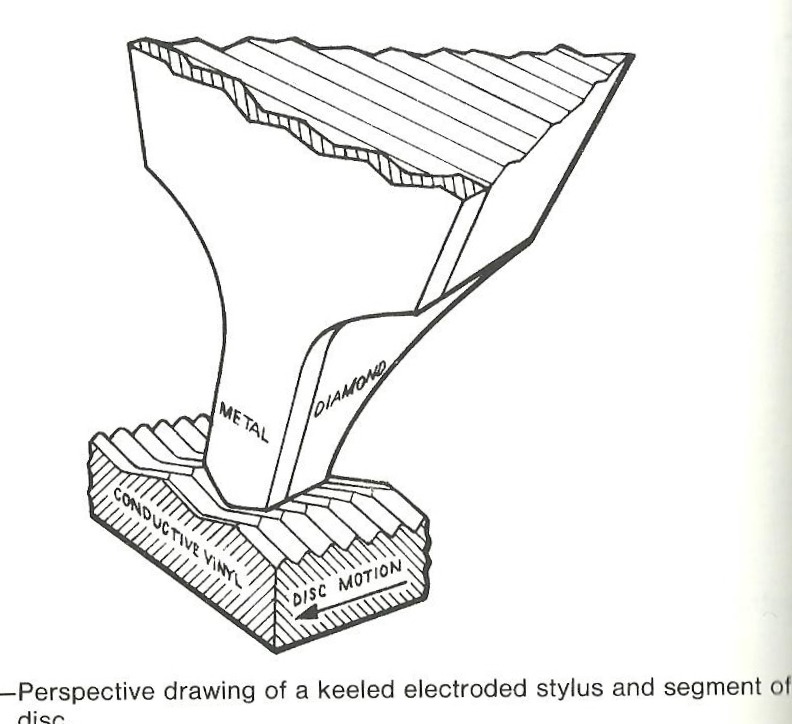
The titanium electrode of the stylus is approximately 2500 angstroms (.25 microns) thick. A human hair is approximately 1 million angstroms thick, meaning you could fit about 400 titanium electrodes in the width of a human hair.
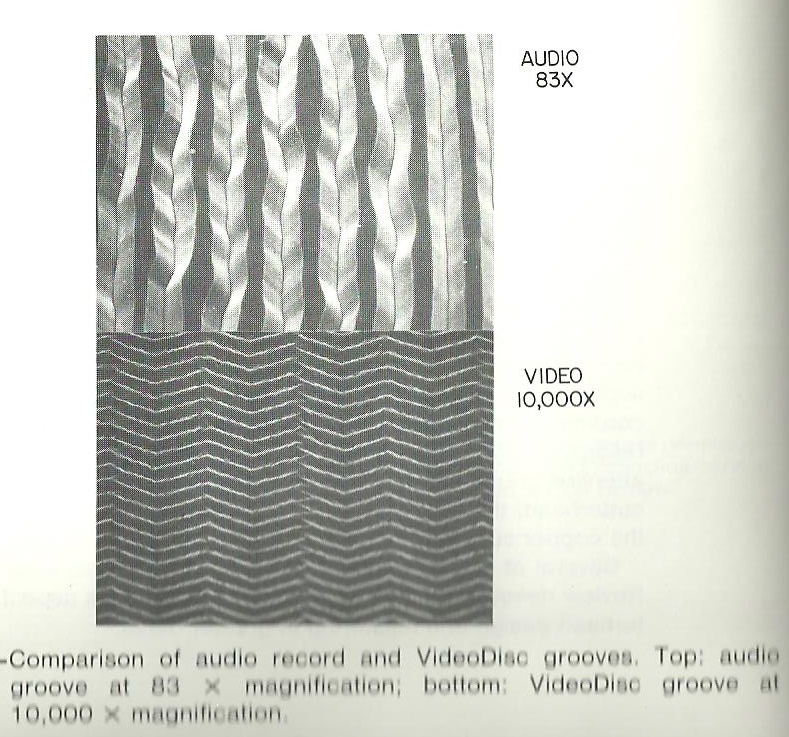
With a new stylus the titanium electrode will last 30-70 hours before it begins to form up. There is a small decrease in signal output at that time. The titanium electrode then only wears as fast as the diamond tip.
At about 65 to 70 milligrams of tracking force the stylus will last about 200 hours with no loss of signal, or at least 50 plays.
How the stylus is constructed,
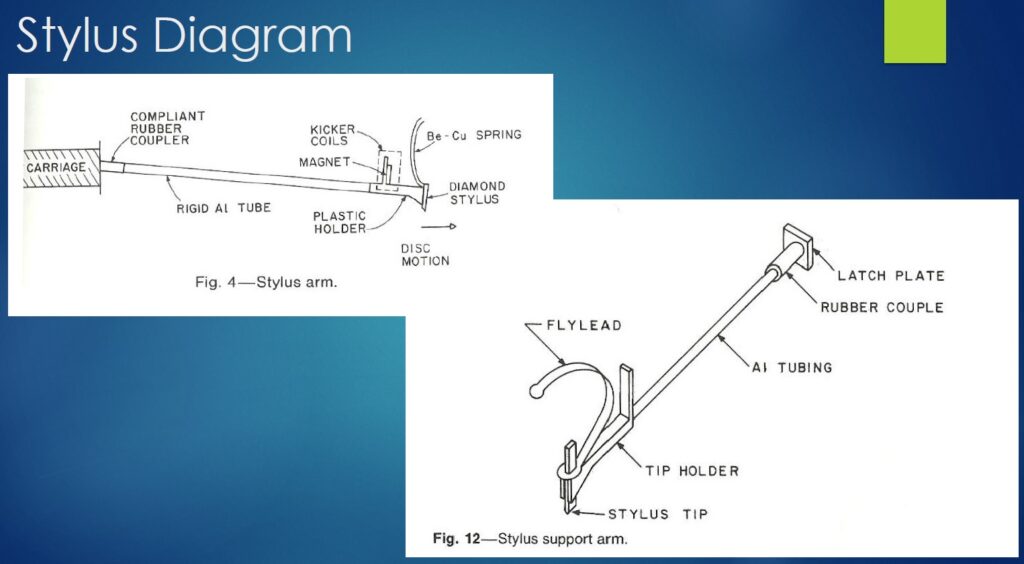
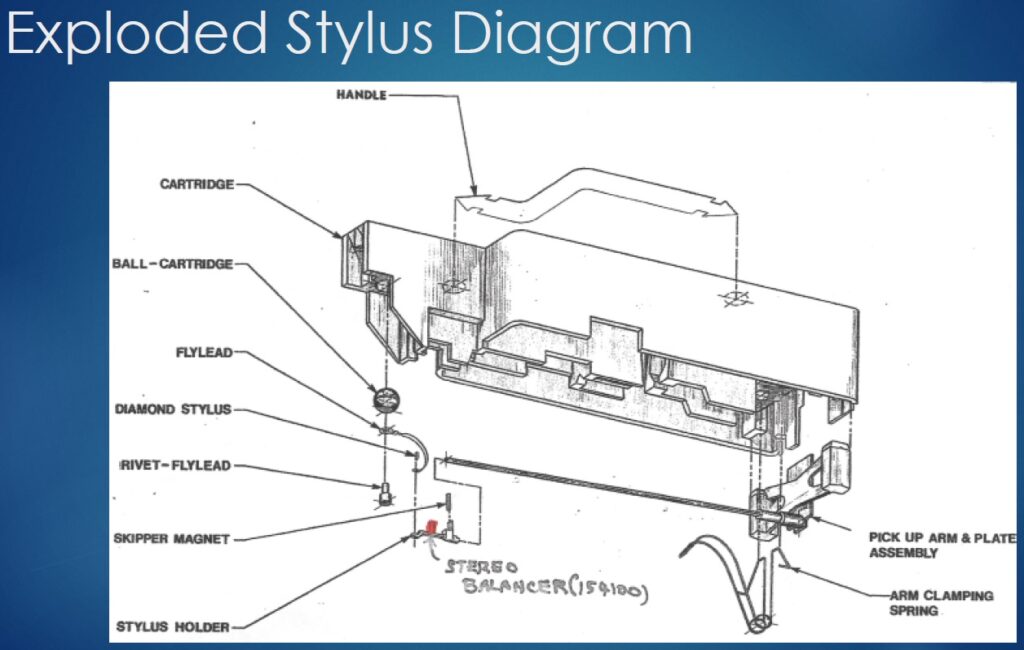
For more information on the stylus please see the March 1978 and March 1982 copies of RCA Review via this link, courtesy of World Radio History. These will have all technical data on how the stylus operates and is constructed.
Click here to go to World Radio History RCA Review
That is all the information I have on styli. I hope it was helpful and you can find a replacement.
-CEDatum